
Low ovarian reserve is often a common cause of female infertility. In assisted reproduction, ovarian failure is an important factor for the success of the treatment, and normally results in obtaining a smaller number of eggs and the need for several stimulation cycles.
To alleviate this, at iGin we apply one of the latest advances in reproductive medicine: the use of Platelet Rich Plasma (PRP) for ovarian reactivation.
What is it?
Our blood has a platelet-rich plasma with a unique ability: to regenerate and repair our own tissues. Today, in our laboratories we are able to obtain this compound from the patient and improve it in order to inject it and thus reactivate her ovarian capacity before a treatment that requires follicular stimulation. This improves the results of mature eggs obtained in the puncture.
How is it done?
The process is simple. A blood sample is taken and the sample is immediately processed in the laboratory to increase the regenerative factors present in the plasma and concentrate them, thus obtaining Platelet Rich Plasma. Then, an intraovarian injection of this compound is performed in the operating room. A very simple procedure that is performed under anesthesia.
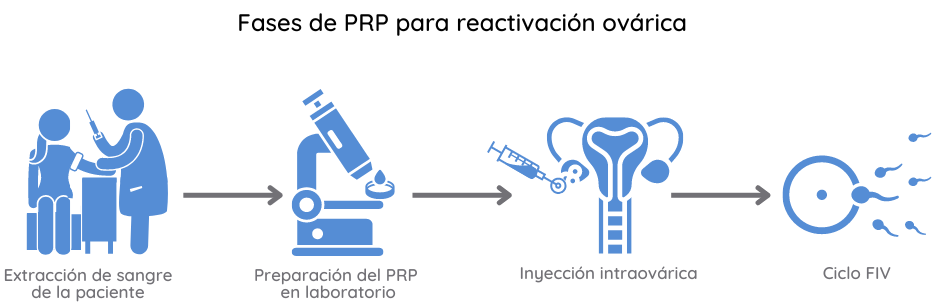
The results are evident within one to three months, at which point a classic treatment with ovarian stimulation (IVF/ICSI, Ropa Method) can be performed to obtain the greatest number of eggs. Sometimes it may be necessary to repeat the technique.
This technique is indicated for patients with low ovarian reserve and severe ovarian failure, especially up to 38 years of age. However, it will be the medical criterion that will assess the convenience of carrying it out based on the probability of success in each particular case.