

Anti-Müllerian hormone analysis

Indicator of the state of your fertility capacity .

Know more

What is the Anti-Müllerian hormone test?

Anti-Müllerian hormone (AMH) is a substance produced by developing ovarian follicles. A blood test for AMH is one of the most reliable and straightforward methods for assessing a woman’s ovarian reserve that is, the number of eggs she still has in her ovaries.

It is a quick and non-invasive test that provides key information for evaluating female fertility.

Who is it for?


This test is mainly recommended for:

Women who are trying to conceive and want to know their ovarian reserve.


Patients who are about to start assisted reproduction treatment.


Women with a family history of early menopause.


Women who wish to preserve their fertility for the future.

What is the Anti-Müllerian hormone test used for?

To assess ovarian reserve and estimate the likelihood of responding to ovarian stimulation treatment.

To determine the most appropriate strategy in assisted reproduction treatments such as IVF/ICSI.

To support decisions about fertility preservation, especially for women who wish to delay motherhood.

To detect possible ovarian disorders, such as polycystic ovary syndrome (PCOS) or premature ovarian insufficiency.

Results

AMH values are interpreted based on the patient’s age and clinical context. Typical interpretations include:
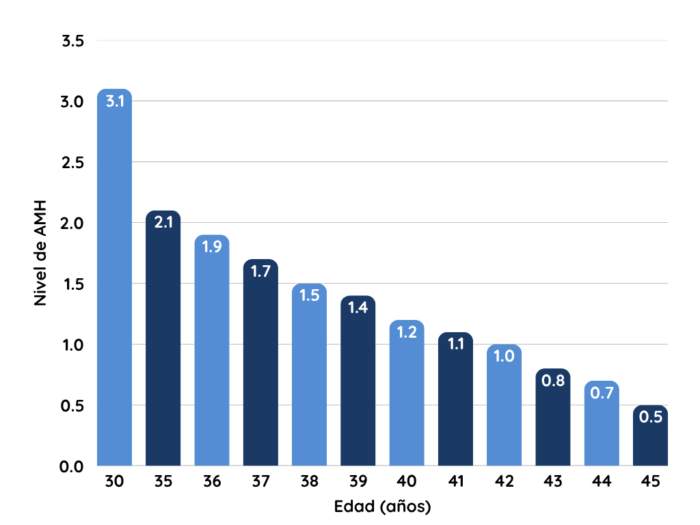
In general:

Low values may indicate a reduced ovarian reserve. This does not necessarily mean infertility, but it may lower the chances of pregnancy and suggest that delaying motherhood is not advisable.

Normal or high values/ suggest a good ovarian reserve, although they do not guarantee pregnancy, as other factors are also involved.

Any questions?

We are here to answer any questions you may have about this, or other techniques and treatments. We will get back to you right away.

Ask us


FAQs about AMH


When should the AMH test be done?
Unlike other hormones, AMH does not fluctuate throughout the menstrual cycle, so the test can be done on any day. This makes the process easier and avoids having to wait for a specific date.
Can I take the test even if I don’t want to get pregnant right now?
Of course. In fact, many women who want to preserve their fertility for the future take this test to determine whether it’s a good time to freeze their eggs. It is also useful for planning motherhood with more information.
What is the difference between AMH and other fertility tests?
AMH directly and consistently measures ovarian reserve. Other tests, such as an ultrasound scan for antral follicle count or FSH level measurements, are also useful and complement this test.
What happens if I have a low AMH level?
A low AMH value indicates a reduced ovarian reserve, which can make conception more difficult, especially if delayed. In these cases, it is important to seek specialized advice to evaluate options such as personalized treatment or egg freezing is pregnancy is not desired.