
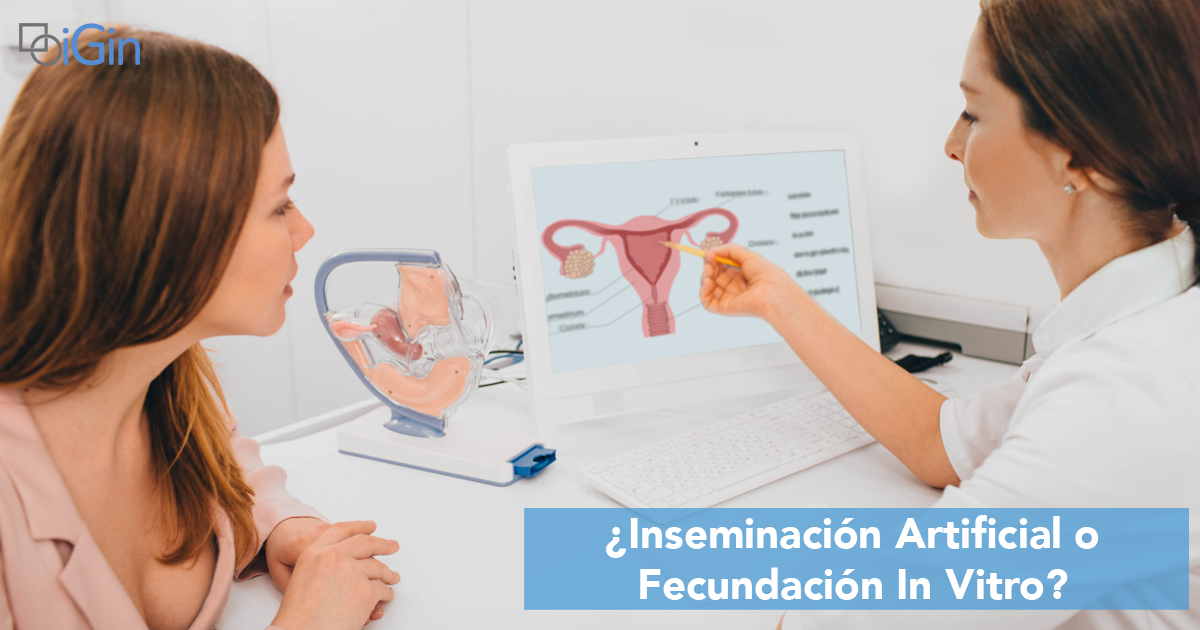
When a woman or couple requires assisted reproduction to achieve pregnancy, it is necessary to find out which is the most appropriate treatment to achieve this.
In Vitro Fertilization (IVF) and Artificial Insemination (AI) are two of the most well-known and common techniques. Both can also be performed using the patients’ own eggs and sperm or, when it is not possible to obtain them, from donors.
After a complete fertility study of the woman and her partner (if any), the specialist will recommend the appropriate treatment based on the results obtained in the tests, the problem found and the estimated success rate for each case.
Differences between AI and IVF
AI consists of depositing capacitated semen (prepared in the laboratory so that the sperm sample has the best concentration and aptitude) in the uterus of the woman, who has previously received mild ovarian stimulation. In this way, fertilization occurs naturally.
It is indicated for simple fertility problems or as a first option in cases of infertility of uncertain origin. To consider it, certain requirements must be met:
- Do not exceed 35/37 years.
- Patent and functional fallopian tubes in women.
- Minimal ovarian alterations.
- The Motile Sperm Count must be greater than five million.
IVF, on the other hand, is a more complex technique. After ovarian stimulation in the woman, the eggs are extracted and fertilized with sperm in the laboratory to create embryos that can then be transferred to the woman’s uterus.
It is recommended when AI has failed, infertility problems are more serious or the woman is over 37 years old. Also when any of these cases occur:
- Women with low ovarian reserve.
- Blocked fallopian tubes.
- Tubal ligation.
- Male fertility problems, such as oligozoospermia, asthenozoospermia or teratozoospermia.
IVF at iGin is performed using the ICSI technique (intracytoplasmic sperm microinjection), which offers high success rates and allows pregnancy to be achieved even in severe cases of male factor infertility.
IVF-ICSI offers a higher probability of achieving pregnancy. At iGin we allow the embryos to reach the bastocyte phase (5 days), which improves the success rates after implantation in the woman’s uterus.
However, there is no technique that is better than another. Each treatment must be tailored to each patient, personalising all procedures as much as possible to increase the success rate.